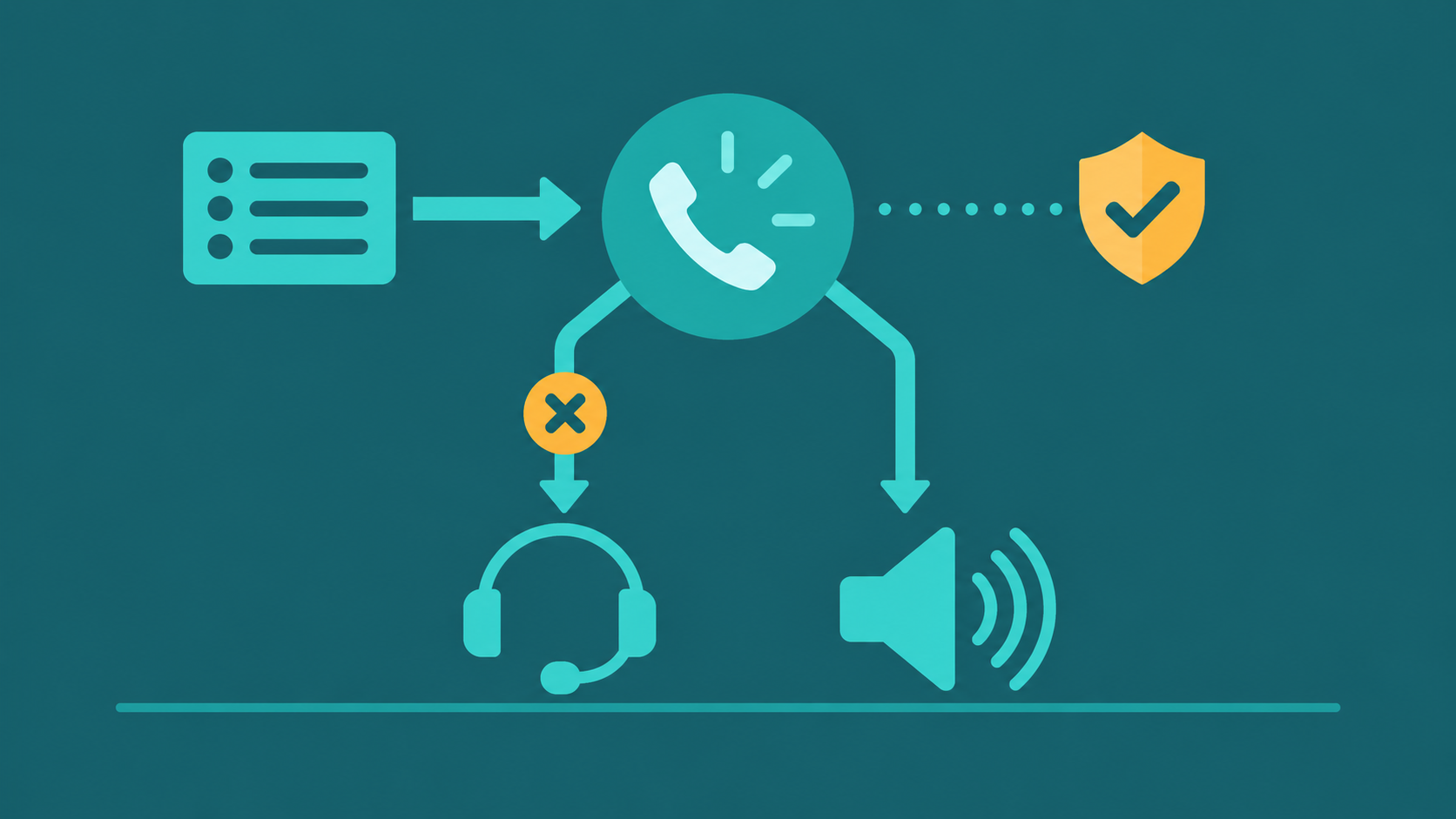
An outbound call center is an operation where agents initiate calls to customers or prospects rather than waiting for inbound demand. The calls have a purpose defined before the dial: closing a sale, qualifying a lead, confirming an appointment, following up on a delinquent account, conducting a customer satisfaction survey, or delivering a proactive service notification like an order delay or payment reminder. That proactive orientation — agents go to the customer, not the other way around — defines everything from the technology stack to the compliance obligations.
Inbound call centers are the inverse: agents sit ready to receive calls from customers who have a question or a problem. The staffing math, the dialer technology, and the legal framework are different. In practice, many modern operations run both directions — a blended contact center where agents handle inbound queues during peak periods and shift to outbound campaigns during slower times. But the outbound call center as a distinct unit, focused exclusively on proactive calling, remains the dominant model for high-volume sales, collections, and outreach programs.
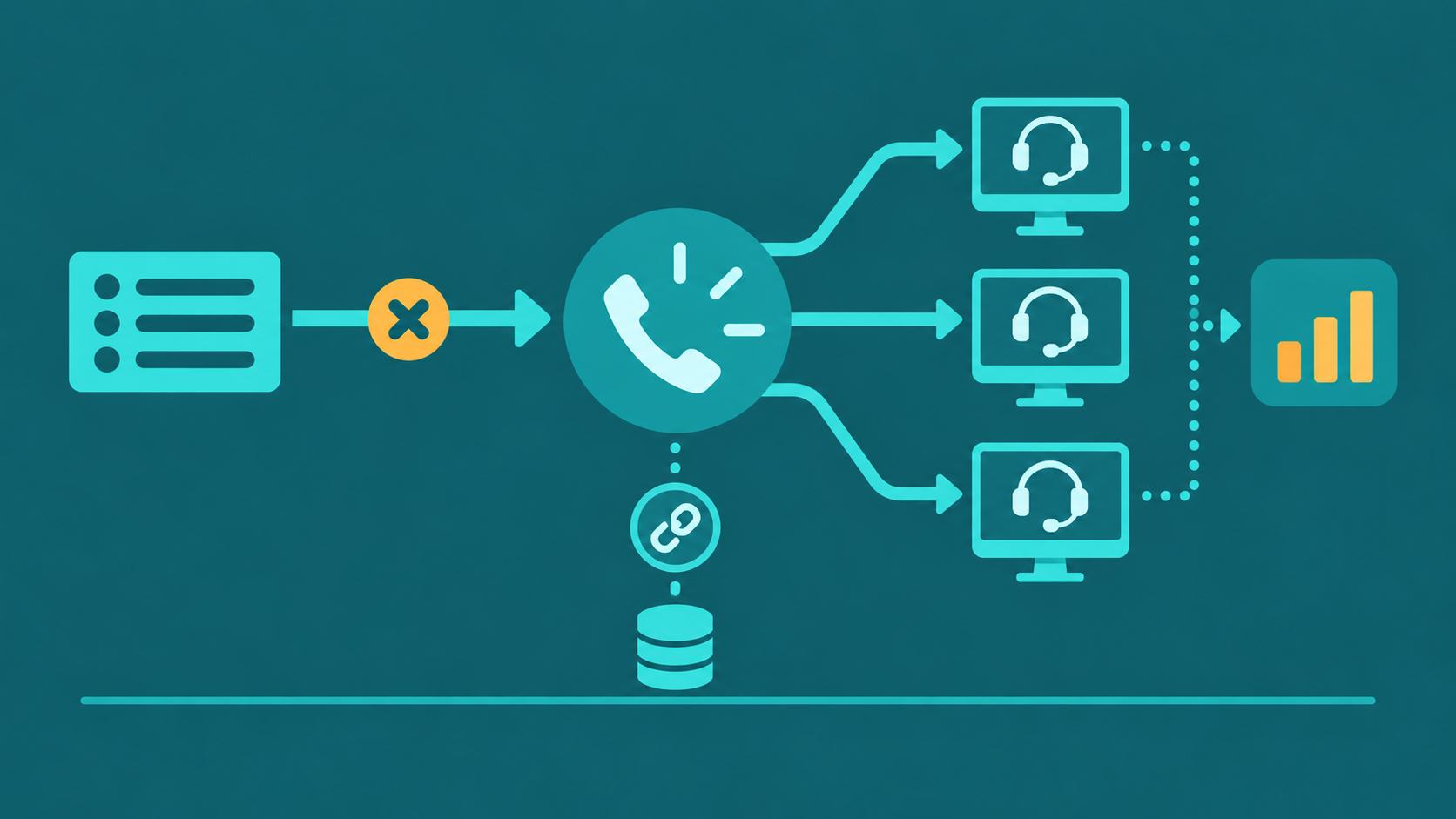
An outbound call center makes proactive calls — for sales, collections, surveys, appointment reminders, or customer outreach. The core tech stack is a VoIP platform with a dialer (predictive, power, or preview), DNC list management, call recording, and a CRM integration. TCPA compliance is the primary legal constraint for outbound calling to US consumers.
Types of Outbound Call Centers
Not all outbound operations look the same. The call type determines the dialer mode, the compliance framework, and how agents are trained and measured.
| Type | Primary Goal | Typical Dialer |
|---|---|---|
| Sales / SDR | Outbound prospecting and lead qualification | Predictive or power dialer |
| Collections | Contacting delinquent accounts | Preview dialer (FDCPA compliance-sensitive); manual dialing also common |
| Survey / Research | Customer satisfaction surveys, market research | Power or preview; lower volumes, longer calls |
| Proactive Service | Appointment reminders, order status, payment notifications | Robocall / IVR or power dialer, depending on consent status |
How to Set Up an Outbound Call Center
- Define your call type and compliance requirements. Determine whether you're calling consumers on cell phones — TCPA applies, and automated dialing (ATDS use) to cell phones for marketing or sales calls requires prior express written consent — or businesses on landlines, where restrictions are fewer. Collections operations layer FDCPA on top of TCPA. The compliance framework you're operating under determines which dialer modes you can legally use before a single call goes out.
- Choose a VoIP platform with outbound-capable dialing. Outbound call centers need a cloud PBX with an integrated or connected dialer — predictive, power, or preview depending on your consent situation. The VoIP platform carries your calls; the dialer manages the calling list and connects answered calls to agents. These two components need to work together without latency gaps that leave answered calls with silence before an agent arrives.
- Build and scrub your calling list. Your contact list is the raw material of every campaign. Scrub it against the National DNC Registry and any applicable state DNC lists before the first dial. Maintain your own internal DNC list for opt-out requests received during calling — federal rules require you to honor internal opt-outs within 30 days. Outdated lists with disconnected numbers inflate abandonment rates and waste agent time without any chance of a conversion.
- Configure call recording and disposition logging. TCPA and FDCPA both create liability exposure — call recordings are your primary legal defense when a consumer disputes a contact. Configure recording on all outbound calls. Agent dispositions (connected, not home, callback requested, DNC requested) must be logged systematically for compliance audits and post-campaign reporting. Missing disposition data makes it impossible to scrub lists accurately for the next campaign.
- Integrate your CRM. Outbound effectiveness degrades fast without CRM integration. Agents need caller context on screen before the call connects — account history, previous dispositions, open opportunities. Dispositions must write back to the contact record automatically. Callbacks must schedule against the agent's queue. A disconnected dialer and CRM setup creates manual data entry work and inconsistencies that compound over time as list quality erodes.
- Set up real-time reporting dashboards. Outbound supervisors need live visibility into dials per hour, talk time, connect rate, abandonment rate, and agent occupancy. Real-time dashboards allow supervisors to identify underperforming campaigns or agents in the moment — not after a shift ends when the data is only useful for the next day's planning. The call center software guide covers what to expect from reporting at different platform tiers.
Key Metrics for Outbound Call Centers
Outbound performance is measured differently than inbound. There's no service level to hit — instead, you're tracking calling efficiency, conversion effectiveness, and compliance thresholds.
| Metric | Definition | Typical Benchmark |
|---|---|---|
| Connect rate (live answer rate) | % of dials that reach a live person | 5–15% for cold lists; 20–40% for warm / prior-consent lists |
| Abandonment rate | % of answered calls where an agent isn't available in time | FTC rule: ≤3% per 30-day campaign |
| Dials per hour | Total outbound call attempts per agent per hour | 40–60 (manual dialing); 80–120 (predictive dialer) |
| Talk time per hour | Minutes of live conversation per agent per hour | 40–50 min/hour target for predictive dialer |
| Conversion rate | % of connected calls that achieve the goal (sale, appointment, payment) | Varies widely by industry — establish baseline in first 30 days |
| Average handle time | Avg call length including wrap-up and disposition time | 3–8 minutes depending on call type |
| First call resolution (collections) | % of accounts resolved on first contact | 20–35% for collections operations |
TCPA Compliance for Outbound Call Centers
The Telephone Consumer Protection Act is the primary legal constraint on outbound calling to US consumers. Violations carry statutory damages of $500–$1,500 per call, and class actions in this area are active. These are the rules that matter most for outbound operations:
- Prior express written consent: Required for automated dialing (ATDS) to cell phones for marketing or sales calls. The FCC's one-to-one consent rule, effective January 2025, requires consent to be specific to each calling business — a consumer consenting to be contacted by one company does not constitute consent for affiliated companies or lead buyers.
- Time restrictions: TCPA limits outbound calls to 8am–9pm local time of the called party. That means the called party's time zone, not your call center's time zone — a distinction that matters for national campaigns run from a single location.
- Abandonment rate cap: When using a predictive dialer, the FTC's Telemarketing Sales Rule caps the abandonment rate at 3% of answered calls per rolling 30-day campaign. Exceeded abandonment triggers required disclosure messages and logging obligations.
- DNC compliance: Federal National DNC Registry plus state-specific lists — California, Florida, and Texas each maintain their own registries with different registration requirements and scrub timelines. Internal DNC lists for opt-out requests received during calling must be honored within 30 days under federal rules, with some states requiring faster turnaround.
- Call recording consent: Twelve states require two-party (all-party) consent for call recording, including California, Florida, and Illinois. Automated disclosure at call start — "this call may be recorded" — is standard practice for multi-state operations. The DNC compliance guide covers state-level variations in depth.
- FDCPA layered on TCPA for collections: Debt collection calls carry additional FDCPA restrictions on calling times, weekly contact frequency per account, required disclosures, and call content. Collections operations typically require preview dialing or manual dialing to maintain the per-account control needed for FDCPA compliance.
The predictive dialer compliance guide covers how pacing algorithms interact with abandonment rate rules in detail.
Choosing outbound call center software: what to evaluate
The software stack for an outbound call center has fewer components than inbound, but the requirements are more specific. A platform that works well for inbound queue management may be poorly suited to high-volume outbound campaigns. Evaluate these dimensions before selecting a platform.
Dialer mode support
Confirm which dialer modes the platform natively supports: predictive, power (progressive), and preview. Some platforms support all three; others are optimized for one mode and offer limited alternatives. Your required dialer mode depends on your call type, team size, and compliance sensitivity — collections operations in regulated environments often require preview or progressive dialing where predictive creates FDCPA exposure, while high-volume lead generation operations need predictive to hit productivity targets. Verify the platform's pacing algorithm is configurable and that the abandonment rate reporting is accurate and accessible in real time, since TCPA compliance depends on it. For dialer mode details, see predictive dialer guide and auto dialer types.
DNC compliance tooling
DNC scrubbing must happen before calls are placed, not after. Verify that the platform scrubs against the National DNC Registry, supports uploading internal DNC lists, and automatically suppresses numbers flagged by agents with a DNC disposition during a campaign. Confirm how the platform handles same-day opt-out requests — federal rules require honoring opt-outs within 30 days, and some state regulations are faster. A platform that requires manual DNC list exports and re-imports creates compliance exposure.
CRM integration depth
Evaluate integration at three levels: screen pop (does the CRM record open when the call connects?), disposition write-back (does the call outcome post to the CRM record automatically?), and list management (can campaigns pull directly from CRM segments without manual exports?). Shallow integrations — screen pop only, with agents manually entering dispositions — degrade data quality rapidly on high-volume campaigns and create duplicate effort. Ask specifically which CRMs are natively supported versus which require a middleware tool or custom build.
Real-time supervisor visibility
Supervisors running outbound campaigns need live dashboards showing per-agent dials, talk time, connect rates, and abandonment rate. The abandonment rate in particular must be visible in real time — a rate climbing toward the regulatory cap requires immediate action (reducing the dial ratio or pausing the campaign), and supervisors who only see daily aggregates cannot respond fast enough. Verify that the platform provides real-time dashboards as a standard feature, not an add-on, and that abandonment rate is reported per-campaign and per-30-day rolling window to match the FTC measurement period.
Recording and quality management
Outbound call recording serves two distinct purposes: regulatory (TCPA/FDCPA documentation, dispute resolution, audit trails) and quality management (coaching, script testing, conversion analysis). Confirm that recording is available for all calls, not just those above a minimum duration, and that the recording library is searchable by agent, date, disposition, and campaign. For operations that use speech analytics, verify the platform's recording output format is compatible with the analytics tool's ingestion pipeline.
Carrier and VoIP infrastructure
High-volume outbound operations place significant load on SIP trunks and VoIP infrastructure. Confirm the platform's outbound CPS (calls per second) capacity matches your campaign requirements — a dialer that can initiate calls faster than the trunk can process them creates pacing problems that undermine both productivity and compliance thresholds. For blended or multi-site operations, verify whether the platform uses per-site or pooled trunk capacity and how failover works when a carrier has a degradation event. See CPS in VoIP for capacity planning context.
Frequently Asked Questions
Related Articles
- Auto Dialer Software: Types & Compliance — covers predictive, power, and preview dialer types and the TCPA rules governing each.
- What Is a Predictive Dialer? — how pacing algorithms work and when to use a predictive dialer vs. alternatives.
- Call Center Software Guide — platform selection, feature tiers, and what inbound and outbound teams actually need.
- What Is the Do Not Call List? — federal and state DNC registry rules, scrub timelines, and internal DNC list requirements.