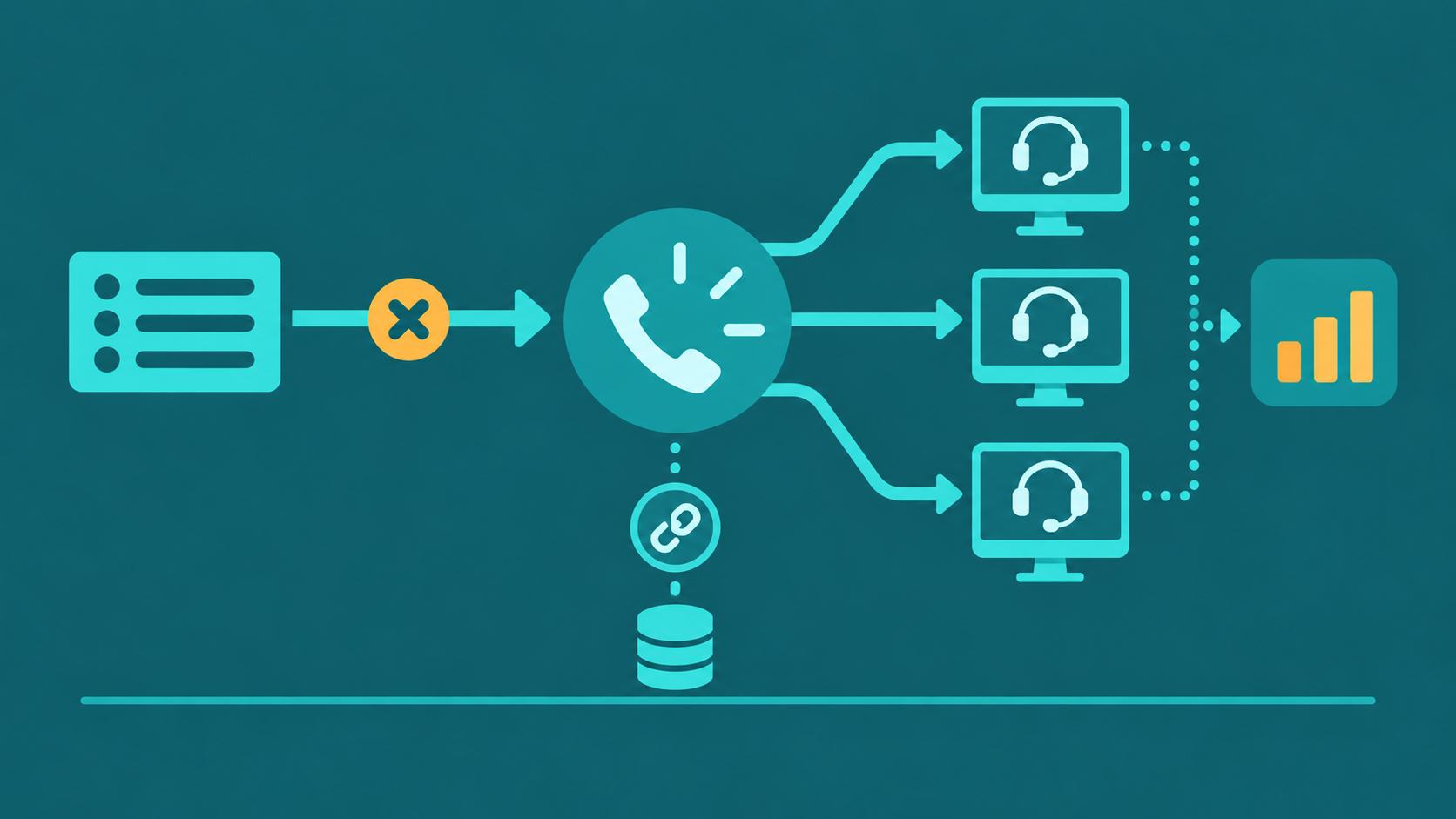
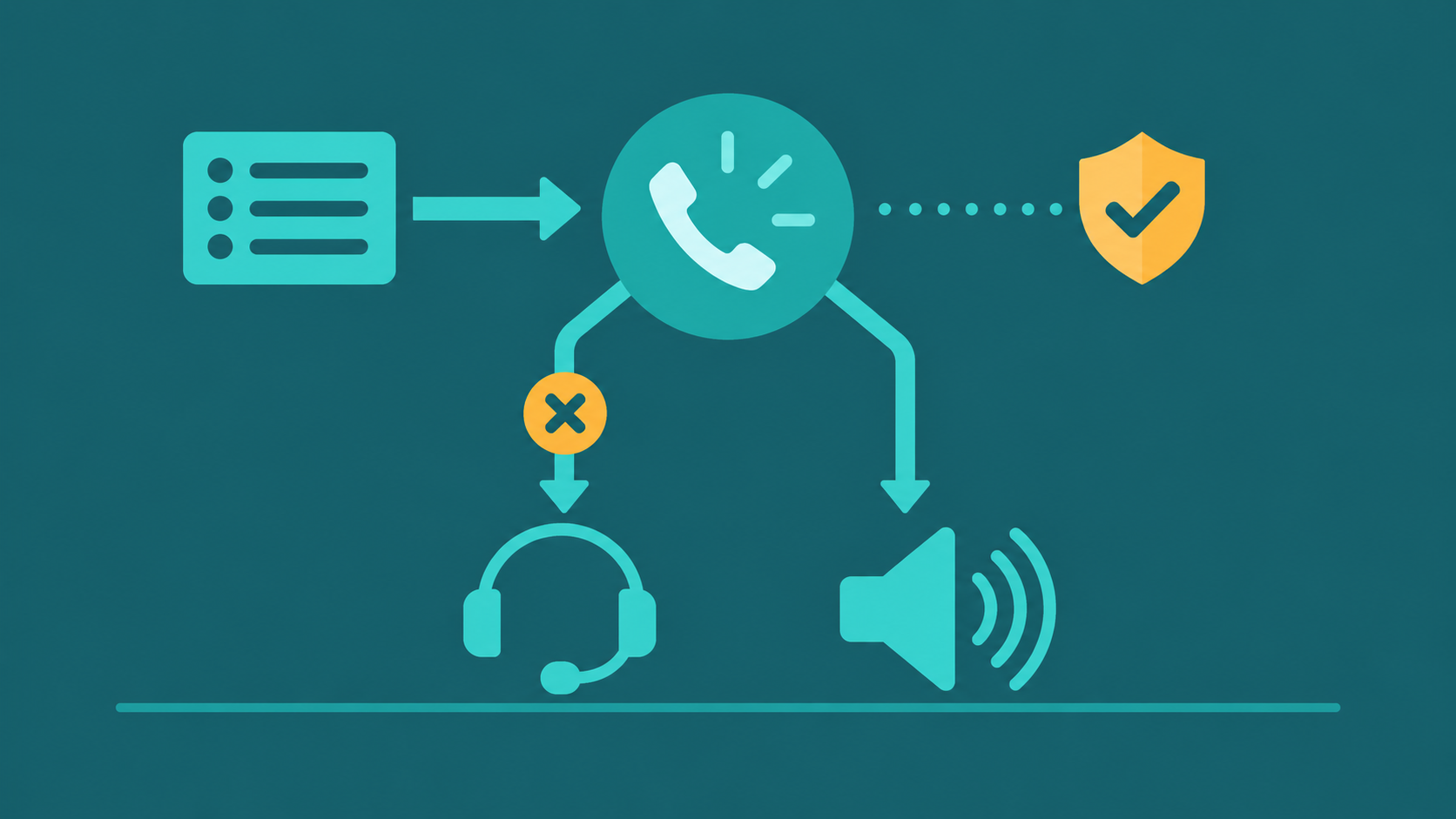
Auto dialer software automatically dials phone numbers from a contact list and handles what happens when a call is answered — connecting it to an available agent or playing a pre-recorded message. The manual dialing step is eliminated entirely, which is the point: agents spend time talking, not dialing. "Auto dialer" is an umbrella term, not a single product. It covers several distinct dialing modes that work differently, serve different use cases, and carry very different compliance obligations.
An auto dialer is software that dials phone numbers automatically from a list. When a call is answered, the dialer connects it to a live agent (predictive, power, preview modes) or plays a pre-recorded message (robocall/voiceblast mode). Compliance rules — especially TCPA — determine which mode a business can legally use for which audience.
Types of Auto Dialers
The four main dialing modes share the same core function — working through a contact list without manual dialing — but differ substantially in how aggressively they dial and what happens when a call connects.
| Dialer Type | How It Works | Best For |
|---|---|---|
| Predictive | Dials multiple numbers simultaneously per available agent using statistical algorithms; answered calls connect instantly; agent idle time near zero; highest compliance risk | High-volume campaigns with 10+ agents; cold list outreach; insurance renewals; debt collections |
| Power | Dials one call per available agent at a 1:1 or 1:1.5 ratio; slightly more idle time than predictive; lower abandonment rate; zero abandoned calls in strict 1:1 mode | Small-to-mid outbound teams; moderate compliance sensitivity; warm lead lists |
| Preview | Agent reviews the contact record before manually initiating the call; slowest throughput; zero abandoned calls; agent has full context before dial | High-value or complex accounts; financial services; any context where agent preparation matters |
| Robocall / Voiceblast | Plays a pre-recorded message to every answered call; no live agent required; maximum reach with minimum staffing; most restricted by TCPA | Mass notifications; political campaigns; nonprofit outreach; appointment reminders where HIPAA context permits |
TCPA and Compliance Rules
The Telephone Consumer Protection Act (TCPA) is the primary federal law governing auto dialer use in the United States. Its reach is broader than many businesses realize, and the consequences for violations — statutory damages of $500 to $1,500 per call — accumulate fast at dialer scale.
The core compliance framework covers several overlapping requirements:
- TCPA's definition of an "autodialer" (ATDS): The FCC interprets this broadly — any system with the capacity to dial automatically from a stored list can trigger TCPA coverage, regardless of whether predictive or random-number-generation features are active.
- Prior express written consent: Calls to cell phones using an ATDS require prior express written consent from the called party. Verbal consent or implied consent is not sufficient for TCPA-covered calls.
- The FCC's one-to-one consent rule (2024): Each lead must provide consent specifically naming the calling business — not blanket consent shared across a lead aggregator's partner list. Purchased consent shared across multiple companies does not satisfy the rule.
- Abandoned call rate: Under the FTC's Telemarketing Sales Rule, predictive dialers must maintain an abandonment rate at or below 3% of answered calls, measured over each 30-day campaign period. Calls that connect to no agent within two seconds of answer count as abandoned.
- DNC compliance: Numbers on the National Do Not Call Registry must be scrubbed before each campaign run. Internal DNC lists — built from opt-out requests received during prior calls — must also be maintained and honored immediately upon request.
- State laws: Florida's FTSA and similar state statutes impose requirements that are stricter than federal TCPA for calls and texts to state residents. Several states require prior express written consent even for calls to landlines in certain contexts.
One important distinction: B2B calls to direct business lines generally face fewer TCPA restrictions than B2C calls to consumer cell phones. Outbound sales teams calling business numbers operate under a lighter regulatory burden, which is why many SDR-focused outbound operations use predictive mode without the same consent infrastructure required for consumer dialing.
Use Cases by Industry
Sales development teams use auto dialers primarily to pursue inbound leads before they go cold. Speed-to-lead is a proven conversion driver — responding to a form submission within five minutes is exponentially more effective than calling an hour later. Predictive and power dialers give SDRs the throughput to work fresh lead lists at pace, cutting the idle time between conversations and increasing talk-time per hour by a factor of two or more compared to manual dialing.
Collections teams in financial services depend on auto dialers to reach delinquent accounts at scale. Both the FDCPA and TCPA apply here, creating a compliance-layered environment where preview dialing is often the preferred mode — agents review account status and balance details before the call connects, reducing the risk of errors or violations during the interaction. Predictive mode is used in higher-volume collections operations where consent documentation and legal review justify it.
Healthcare organizations use outbound dialing for appointment reminders, recall campaigns, and chronic care check-ins. Robocall mode handles high-volume reminder calls where HIPAA-appropriate pre-recorded messaging is sufficient. Live-agent mode — typically power or preview — handles more complex scheduling conversations or patient outreach where the call requires judgment and response to patient questions. HIPAA adds a layer of requirements around call recording, data handling, and what information can be included in a pre-recorded message.
Political campaigns and nonprofits use voiceblast extensively for mass constituent and donor communication. Federal rules treat certain political and nonprofit calls differently from commercial telemarketing — calls from political organizations to cell phones without prior consent occupy a contested legal space that has shifted with court rulings and FCC guidance. Organizations in this space should verify current guidance before launching robocall campaigns to mobile numbers.
Key Features to Evaluate
- DNC scrubbing. Real-time scrubbing against the federal National DNC Registry and any applicable state registries before each dial attempt, plus internal DNC list management that updates immediately when a called party requests removal. Campaigns should never start without a scrub run against a current list.
- Abandonment rate controls. A configurable abandonment cap with automatic enforcement — not just a dashboard metric. Predictive dialers should be able to play an FTC-compliant automated message to abandoned calls and document each abandoned call for audit purposes.
- CRM integration. Bidirectional sync with Salesforce, HubSpot, Zoho, or your CRM of choice — call dispositions write back automatically, and the contact record loads on screen pop when a call connects. Agents should never be searching for a record after answering.
- Call recording and disposition logging. Full call recording with searchable notes and outcome codes. Every call disposition should create a timestamped audit trail — essential for both sales coaching and TCPA compliance documentation.
- Reporting by campaign. Dials, connects, talk time, dispositions, and abandonment rate broken out per campaign — not just rolled up into aggregate totals. Campaign-level data is what actually tells you whether a list, a time window, or a message approach is working.