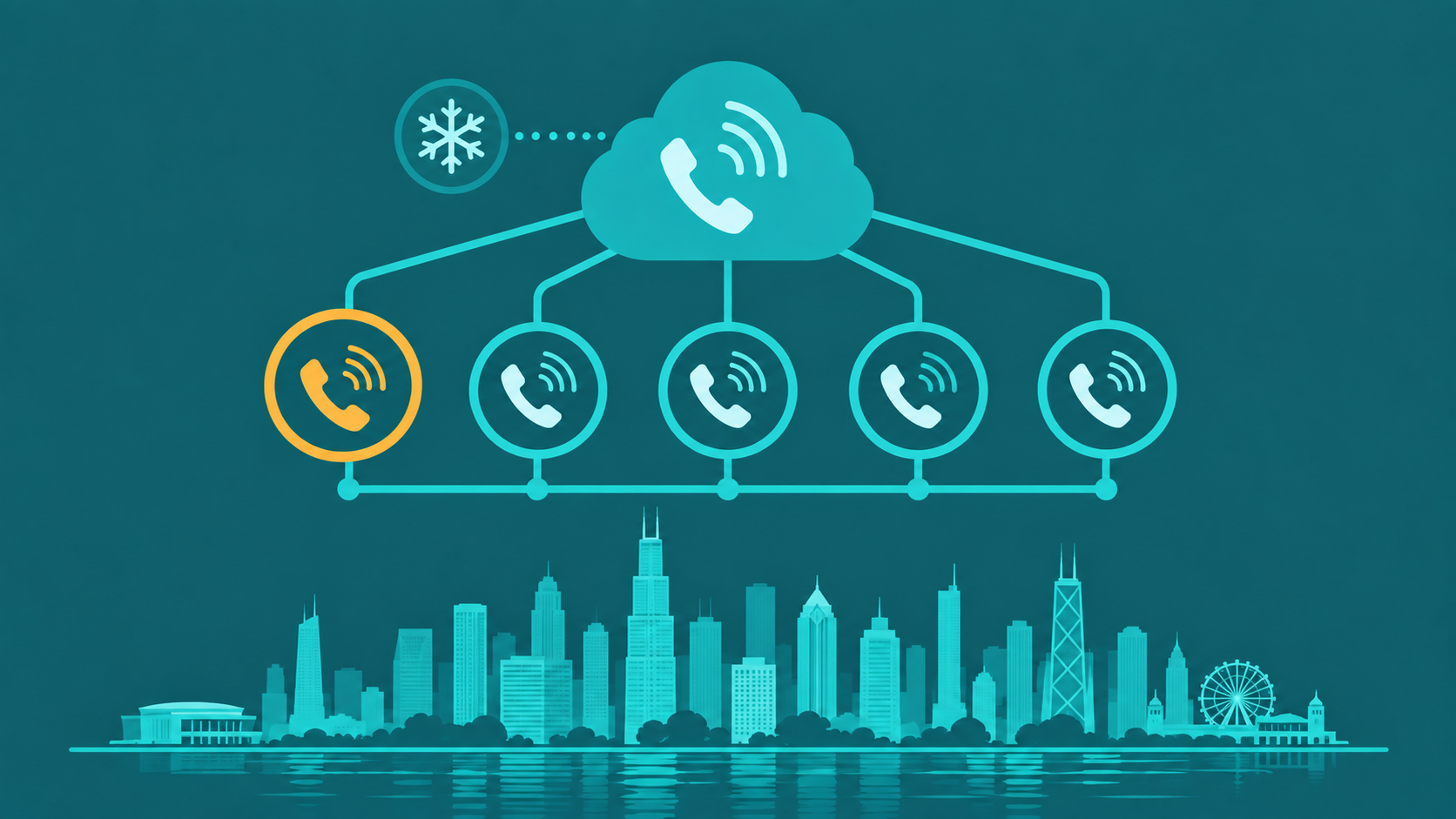
Chicago's business density — from the Loop's financial district to the West Loop tech corridor — creates specific phone system requirements. With five active area codes spanning the city and collar counties, and a climate that pushes businesses toward remote and hybrid work models in winter, Chicago businesses need VoIP systems that deliver local number coverage across the entire Chicago Metropolitan Statistical Area and remain accessible regardless of whether employees are in the office on a given day.
Chicago business VoIP should cover all five area codes (312/773/872 for the city; 708 and 630 for suburbs), support remote and hybrid work for weather-related office disruptions common in the Midwest, and scale across the collar counties where many Chicago-area businesses have distributed offices. Cloud VoIP with a mobile softphone is particularly practical for a Chicago workforce that regularly works from home during winter weather events.
Chicago's Five Area Codes
Understanding which area code belongs where matters before you provision numbers. Chicago operates under five distinct area codes, and local credibility often depends on having the right one for the right geography.
312 is the original Chicago area code, covering the Loop, Near North Side, River North, and the West Loop — the core of the city's business district. A 312 number carries a particular signal for established downtown presence, and many financial and legal firms specifically seek it out when setting up new lines. New 312 inventory is more constrained than other codes, but porting existing 312 numbers is straightforward.
773 covers city neighborhoods outside the central business district: Lincoln Park, Logan Square, Hyde Park, Pilsen, Wicker Park, and Rogers Park, among others. Businesses based in these neighborhoods — medical offices, studios, small professional firms — typically use 773 numbers to signal a local presence in their specific community rather than downtown.
872 is an overlay code that covers the same geographic footprint as both 312 and 773. New numbers in the city are often issued as 872 DIDs. For businesses without a strong preference for a specific code, 872 is a practical choice with good inventory availability.
708 serves the inner suburban ring: Oak Park, Evanston, Cicero, Berwyn, Harvey, and Calumet City. Companies with offices or client bases in these communities need 708 numbers to avoid appearing as an out-of-area caller.
630 covers the western suburbs — Naperville, Aurora, Wheaton, Downers Grove, and Lombard. The 630 corridor is home to a significant concentration of corporate headquarters and distribution operations, particularly around the I-88 tech corridor between Naperville and Oak Brook. A VoIP provider serving Chicago-area businesses must be able to issue and port numbers across all five codes, not just 312.
VoIP vs. Landline in Chicago
| Factor | Cloud VoIP | Landline (AT&T Illinois / Comcast) |
|---|---|---|
| Area code coverage | All five Chicago-area codes (312/773/872/708/630) | Service area dependent; suburban codes may require a separate circuit |
| Winter weather resilience | Mobile app continues on cellular when the office closes; remote agents stay on the same system | Physical line requires in-office presence; no remote fallback |
| Multi-office support | Single cloud platform across the Loop, suburbs, and remote workers | Separate circuits per location; no unified extension dialing |
| Installation time | Same-day provisioning | 1–3 weeks; field technician required |
| Cost | $20–$45/seat/month; no hardware contracts | $40–$80/line/month plus equipment; typically requires a multi-year contract |
How Chicago Businesses Use VoIP
Financial services. The CME Group, Chicago Board of Trade, and a dense concentration of trading firms, private equity shops, and asset managers make Chicago one of the top financial services markets in the US. These organizations need direct-dial 312 numbers for traders and analysts, call recording for regulatory compliance, and multi-site connectivity between Loop offices and suburban operations centers. VoIP makes it practical to extend the same phone system to a back-office facility in Naperville without adding a separate phone contract.
Legal. Chicago hosts some of the largest law firms in the country, and Cook County courts drive constant attorney-client communication. Firms need call recording, direct inward dial numbers per attorney, and CRM integration with practice management platforms. The mobility requirement is high — an attorney in court still needs to receive calls on their published business number, which a softphone handles without forwarding gaps.
Healthcare. Northwestern Medicine, Rush University Medical Center, and UIC Health anchor a large healthcare ecosystem that extends across the city and into the suburbs. HIPAA-compliant VoIP with a signed Business Associate Agreement is a baseline requirement for covered entities. Multi-campus call routing — connecting patients to the right specialist location without a manual transfer chain — is a common configuration need.
Manufacturing and logistics. O'Hare International Airport makes Chicago a North American distribution hub. Logistics companies, third-party logistics providers, and manufacturers with facilities in the collar counties need VoIP systems that connect a Loop or Rosemont administrative office with suburban warehouses on a unified extension plan, so dispatchers and warehouse supervisors reach each other by four-digit dialing rather than external calls.
Technology. The River North and West Loop tech corridors have grown significantly over the past decade. Chicago's tech companies typically use VoIP for distributed teams, with remote workers spread across the Midwest and a softphone-first approach that avoids desk phone hardware entirely. When a blizzard keeps half the team at home, the phone system operates without adjustment.
Choosing a VoIP Provider for Chicago
Five-area-code coverage. Verify the provider can issue new DIDs and port existing numbers across 312, 773, 872, 708, and 630 before signing. Suburban offices in Naperville (630) or Oak Park (708) need local numbers from those area codes to signal credibility in their specific market — a 312 number does not convey local presence in the western suburbs.
Remote and hybrid work support. Chicago's winters drive remote work more than most US markets. The softphone must work reliably on cellular and residential internet, and the system should automatically reroute calls to mobile when an office is closed for weather. Ask specifically whether call queue assignments and supervisor monitoring carry over to remote agents or require manual reconfiguration.
Multi-site unified dialing. A Chicago business with Loop offices and suburban locations needs four-digit extension dialing across all sites, shared call queues, and a single admin portal. Multi-site configurations that require separate system management per location create overhead that compounds as the business grows.
ISP compatibility. AT&T Business Fiber and Comcast Business are the dominant ISPs in the Chicago metro. Confirm your VoIP provider has validated call quality on both and can provide ISP-specific QoS recommendations for your connection type — a generic QoS guide is less useful than guidance tuned to cable versus fiber upload/download asymmetry.
24/7 Central Time support. Chicago operates on CT. A VoIP provider whose support team opens at 9am ET leaves Chicago businesses unreachable during the 7–9am CT window when offices open and call volume begins. For businesses that open early — trading firms, logistics dispatchers, healthcare facilities — this gap is operationally significant.
Frequently Asked Questions
Related Articles
- Business VoIP Guide — The business VoIP guide covers how cloud phone systems work, pricing structures, and what to evaluate before switching from a traditional PBX.
- VoIP Providers: How to Compare — The VoIP providers comparison guide walks through the criteria that separate providers in depth, including number portability, contract terms, and call quality benchmarks.
- Hosted VoIP: How It Works — The hosted VoIP guide explains the infrastructure behind cloud phone systems and why hardware ownership is no longer required.
- VoIP Failover: Keeping Calls Live During Outages — The VoIP failover guide covers redundancy configurations relevant to any market where weather or internet disruptions are a real operational concern.