
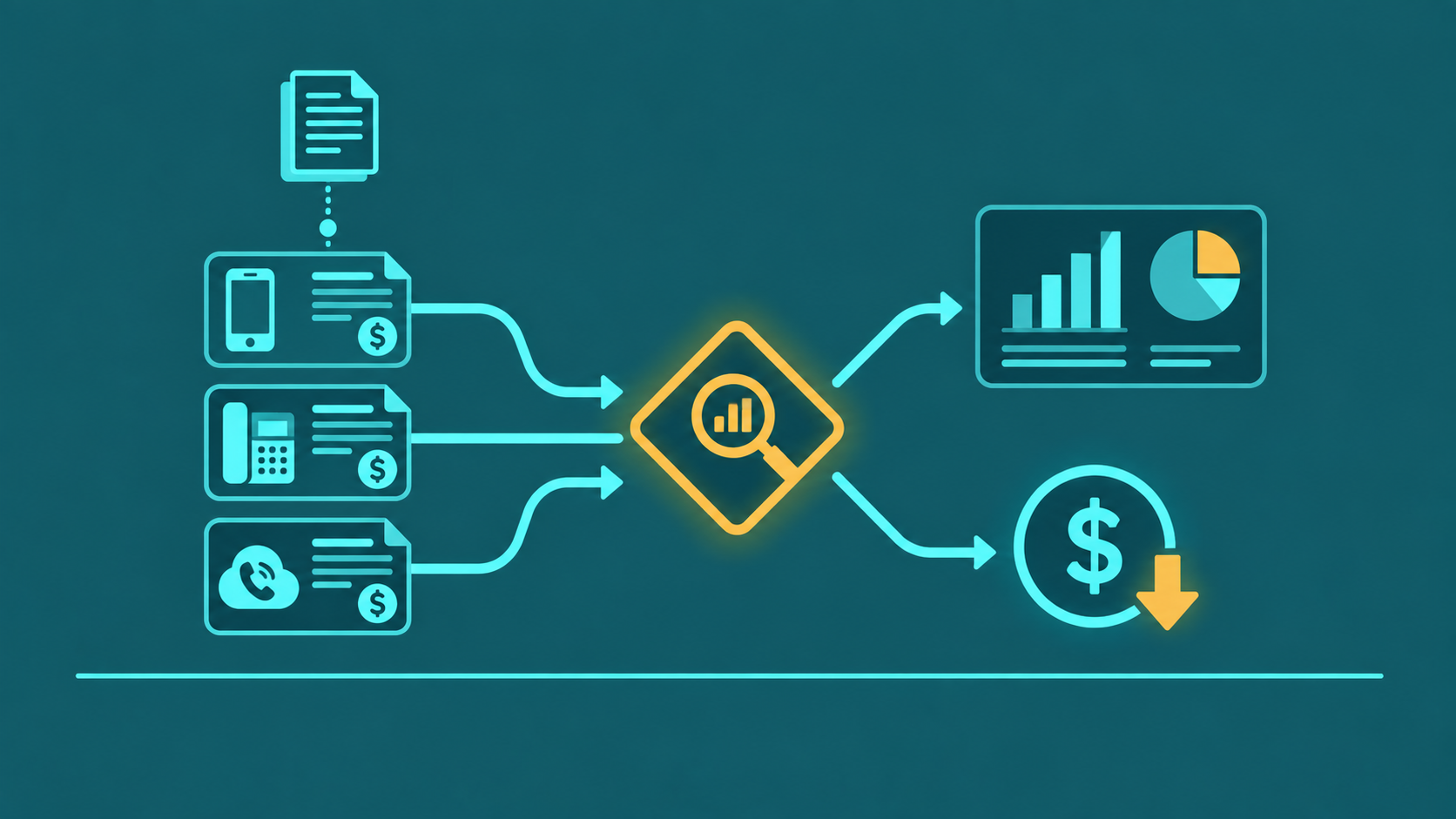
Telecom bills are among the most error-prone invoices a business pays. Carrier billing systems are complex, contracts are long, and most finance teams do not have the expertise to validate what they are being charged. The result is that most businesses overpay — sometimes significantly — for telecommunications services every month without knowing it.
Telecom expense management (TEM) is the structured discipline of auditing, tracking, and optimizing those costs. This guide explains what TEM covers, how software and managed services compare, what businesses typically overpay, and how to implement a TEM program.
Telecom expense management (TEM) is the process of auditing, tracking, and optimizing a business's telecom invoices, contracts, and usage — covering mobile, fixed-line, VoIP, data, and cloud communication costs. Companies use TEM software or services to catch billing errors, eliminate unused lines, and benchmark carrier pricing.
Why telecom bills are hard to manage
Most businesses have more telecom complexity than they realize. A mid-size company with 100 employees might have: a multi-site SIP trunk agreement with one carrier, mobile device plans from two or three national carriers, broadband internet circuits at each office location, legacy copper lines still active at some locations, a cloud UCaaS platform with a separate per-seat license, and toll-free number contracts with overage clauses.
Each of these creates a separate invoice, often with different billing cycles, different billing formats, and contract terms that do not align. The specific problems that make these invoices hard to manage include:
- Complex carrier invoice formats. Carrier bills are notoriously long and detailed, with line items for regulatory fees, surcharges, taxes, and feature add-ons that are difficult to validate without understanding the original contract terms they correspond to.
- Multiple contracts with different terms. Businesses rarely have a single telecom supplier. Managing five or more contracts with different renewal dates, early termination penalties, and rate adjustment clauses is a significant administrative burden.
- Hidden fees and surcharges. Carriers add regulatory recovery fees, administrative charges, and surcharges that are not directly tied to negotiated rates. These accumulate over time and are rarely scrutinized in routine invoice reviews.
- Unused lines and services. Employee turnover, office moves, and system migrations leave orphaned lines — phone numbers or circuits that are still being billed but no longer used. Identifying and disconnecting them requires an inventory of active services that most businesses do not maintain.
- Contract rate drift. Rates negotiated at contract signing may increase at renewal, or a carrier may apply surcharges that effectively raise the effective rate above the contracted level without a formal rate change notification.
TEM software vs managed TEM services
| Dimension | TEM software | Managed TEM services |
|---|---|---|
| Who runs it | Your internal team | External TEM provider staff |
| Best for | Businesses with dedicated telecom staff | Businesses without in-house telecom expertise |
| Cost | Software subscription fee | Service fee, often % of identified savings |
| Control | Full control over decisions and processes | Shared; provider handles carrier disputes |
| Reporting | Self-service dashboards and exports | Provider-generated reports and recommendations |
The right choice depends on whether your business has internal capacity to use software effectively. Many businesses find that the initial implementation — loading invoices, mapping contracts, building an inventory — requires more effort than expected, and that a managed TEM service delivers faster savings during the first year. Software is more cost-effective over a long time horizon once processes are established.
Seven things TEM covers
A complete TEM program addresses every stage of the telecom lifecycle:
- Invoice auditing. Comparing every line item on every carrier invoice against contracted rates and approved services. Errors caught here — overcharges, duplicate billing, wrong plan codes — typically generate the most immediate savings.
- Contract management. Centralizing all telecom contracts with renewal dates, rate terms, minimum commitments, and early termination clauses in a single repository. Prevents missed renewal windows that auto-renew at unfavorable rates.
- Usage analytics. Analyzing call detail records and data consumption to identify underutilized services, overpayment for unused capacity, and opportunities to right-size plans to actual usage.
- Inventory management. Maintaining a current record of every active line, circuit, mobile device, and service — mapped to the employee or location it serves. The foundation for identifying orphaned and unused services.
- Dispute resolution. Filing and managing billing disputes with carriers when audit findings identify overcharges. Carrier dispute processes are slow and require persistence; managed TEM services handle this on behalf of the client.
- Benchmarking. Comparing your carrier rates against current market rates for equivalent services. Establishes negotiating leverage when contracts come up for renewal.
- Optimization recommendations. Identifying structural changes — consolidating carriers, switching to a different service tier, migrating a legacy circuit to a cloud equivalent — that reduce cost beyond what auditing alone can achieve.
How much businesses typically overpay on telecom
Industry research consistently finds that businesses overpay on telecom by 20–40% of their total spend. The most common sources of overpayment are:
- Unused lines. Orphaned lines from departed employees, closed locations, or decommissioned systems. Estimates suggest that 7–12% of business phone lines are unused at any given time.
- Billing errors. Carrier billing errors — incorrect rate codes, misapplied discounts, duplicate line items — are common and often persist for months before anyone notices. A structured audit typically recovers 3–8% of telecom spend in billing credits.
- Over-provisioned plans. Mobile plans with data allowances that exceed actual consumption by a significant margin, or SIP trunk configurations with more channels than the business actually uses at peak.
- Expired promotional rates. Introductory pricing that reverts to standard rates after an initial term without triggering a notification that prompts renegotiation.
TEM and VoIP/UCaaS: how cloud migration changes the picture
The shift from legacy fixed-line infrastructure to cloud VoIP and UCaaS changes the TEM landscape in several important ways. Legacy telecom — POTS lines, ISDN circuits, dedicated voice T1s — generates complex carrier bills with per-line charges, circuit fees, and regulatory surcharges that TEM tools were originally designed to process.
Cloud VoIP simplifies billing: most platforms charge a flat per-seat monthly fee or a per-minute consumption rate with no circuit fees, no regulatory surcharges buried in the bill, and no separate hardware maintenance contracts. The invoice is simpler and easier to audit.
However, cloud migration introduces new TEM considerations. UCaaS platforms often have usage-based overage charges for international calls, toll-free minutes, or SMS volume. Businesses that migrate without auditing usage patterns may switch from a complex legacy bill to a simpler cloud bill that is still larger than necessary because plan tiers or add-ons were sized incorrectly.
TEM programs that include cloud VoIP and UCaaS should audit per-seat utilization (licenses assigned to users who no longer need them), international call volume against contracted rates, and add-on feature subscriptions that are not being used. For an overview of how the full business telecom stack — voice, internet, conferencing, and messaging — fits together before or after a cloud migration, see our business telecommunications solutions guide.
Steps to implement a TEM program
A practical TEM implementation follows a structured sequence:
- Inventory all telecom services. Compile every carrier relationship, contract, account number, and associated invoice. Include mobile, fixed-line, internet, VoIP, conferencing, and cloud communication platforms. Most businesses discover they have more active accounts than expected.
- Obtain and centralize invoices. Collect the last 3–6 months of invoices for each carrier. For managed services, provide carrier access credentials so the TEM provider can pull invoices directly. For software, configure automated invoice collection via carrier portals where available.
- Map contracts to invoices. For each contract, identify the corresponding invoice accounts and the rate terms that should govern billing. This mapping is the foundation for catching discrepancies.
- Conduct an initial audit. Compare each invoice line item against contracted rates. Flag discrepancies for investigation. Prioritize the largest accounts and the invoices with the most complex line items.
- File disputes and recover credits. For confirmed billing errors, file disputes with carriers. Keep records of all dispute submissions and track resolution. Most carriers have formal dispute processes with defined response timelines.
- Deactivate unused services. Submit disconnection orders for confirmed orphaned lines and unused services. Document the inventory change in your TEM system.
- Establish ongoing monitoring. Configure automated alerts for invoice anomalies — charges that exceed expected amounts, new line items that did not appear in prior months, or rate increases — so that future billing errors are caught in the current billing cycle rather than discovered months later.